


Introduction to Dhrupad Music
 1-on-1 Class
Beginner
by Mukund Dev
20 Years Experience
Trained at the Dhrupad Sansthan, Bhopal under Padma Shri Gundecha Brothers. Performer at NCPA Mumbai, Saptak Festival, and the International Dhrupad Mela, Varanasi. 200+ students trained across India and abroad. Now teaching Dhrupad on ipassio - to students at every level, anywhere in the world.
US $30 per class |
for 1-on-1, 45 mins class
Recommended: 1 class per week | 12-16 weeks to level up
 Pay as you go, 2 classes at a time
You can choose your time slots in the next step. ipassio has thousands of happy learners from the US, Canada, Australia, UK, Europe, UAE, and India.
Instruction Language
: English, Hindi
Course Summary
Most people who discover Dhrupad feel something they cannot immediately explain. A stillness. A depth. A sense that this music is not just heard but felt in the body.
Dhrupad is the oldest form of Indian classical music, rooted in Nāda Yoga, the science of how sound transforms consciousness from the inside out.
But Dhrupad is also one of the least accessible classical forms to learn. Authentic transmission requires a teacher who carries the tradition, not just the technique. The Dagar Vani lineage, preserved through generations and taught at the Dhrupad Sansthan in Bhopal, is one of the most respected in the world. It is from this lineage that Mukund Dev teaches.
In this course, every session is live and 1-on-1. Mukund listens to how you sing, assesses where you are, and builds your learning entirely around your voice, your pace, and your goals. The curriculum is drawn from traditional Gurukul methodology, made accessible for today's learner without sacrificing depth.
This is not a course about covering material. It is a Sadhana - a sustained, personal practice that develops voice, breath, listening, and awareness together.
Learn on

ipassio Video

Google Meet

WhatsApp Video

BOTIM

Zoom
Teacher's Profile

Teacher Skill Keywords
Indian Classical Music, Vocal Training
Education
M.Mus from Master of Music in Hindustani Vocal, University Of Mumbai
B.Mus from Bachelor of Music in Hindustani Vocal, Utkal University of Culture

Work Details
Chairman - Dhrupad Music Foundation
About the Course
This beginner programme is a complete introduction to Dhrupad designed for students who are approaching this tradition for the first time, with no prior musical training required. You will not be learning songs. You will be learning how to listen, how to breathe, how to place sound, and how to build a voice that can carry the depth this music demands.
The sequence is intentional where each element builds on the last. Progress is not measured by speed but by the depth and steadiness of your practice.
Introduction to Nāda, Shruti, and Swara
Before a note is sung, it must be understood. This opening module introduces the foundational philosophy of Dhrupad -
- Nāda - the primordial sound that underlies all music;
- Shruti - the microtonal intervals between notes that give Indian classical music its emotional precision; and
- Swara - the seven notes of the scale and their relationships.
You will learn to hear these distinctions, not just sing them, but also develop the inner ear that all serious Dhrupad practice requires.
Basic Kharaj Sadhana - building the voice from its foundation
Kharaj Sadhana is the cornerstone of Dhrupad voice culture.
Kharaj Sadhana includes a daily practice of sustained low-register singing that develops vocal depth, resonance, and stability from the ground up.
Most vocal training begins in the middle or upper registers. Dhrupad begins at the root.
Mukund Ji will guide you through the correct posture, breath engagement, and tonal placement for Kharaj practice.
It will help you build a voice that is full, steady, and capable of the long, sustained phrases Dhrupad requires. This module is practised daily throughout the entire beginner programme.
Swara Practice and Sargam - Pitch Precision and Scale
The practice of singing the seven Swaras Sa, Re, Ga, Ma, Pa, Dha, Ni is the primary tool for developing pitch accuracy and scale awareness.
In this module you will practise ascending and descending Sargam patterns at varying tempos, developing the ability to place each Swara precisely within the tonal field established by the Tanpura. Mukund listens to your Sargam in every session and corrects Shruti alignment in real time — the kind of correction that is only possible when a trained teacher is hearing you live.
Introduction to simple Ragas - Yaman and Bhupali
Every raga has a personality. A set of characteristic phrases, a specific emotional essence, and a grammar of notes that defines how a particular musical world is entered and explored.
Beginners in this programme are introduced to -
- Yaman - the evening Raga that creates an atmosphere of expansive, yearning beauty
- Bhupali - a five-note Raga of serenity and devotional stillness.
You will learn not just the notes of each Raga but its characteristic movements, its forbidden notes, and the emotional quality it is designed to evoke.
Basic Alap development - entering the Raga note by note
Alap is the meditative, unaccompanied exploration of a Raga. There is no rhythm, no composition, no fixed structure. Just the voice and the Raga, moving slowly through the tonal space, note by note, phrase by phrase.
At the beginner level, Alap practice begins with simple, short movements between adjacent notes in the lower register of the Raga, developing the capacity to stay within the Raga's grammar, dwell on significant notes, and move with intention rather than haste.
This is one of the most distinctive and challenging aspects of Dhrupad for new students and also one of the most transformative.
Introduction to Tala
In Dhrupad, rhythm forms the basic architecture. This module introduces the concept of Tala: the rhythmic cycle within which compositions are set.
You will begin with the fundamental Talas used in Dhrupad -
- Chautala (12 beats)
- Dhamar (14 beats)
You will learn to clap, count, and internalise the cycle before applying it to singing.
The outcome of these lessons and exercises will give you a deep understanding of the beats. It will enhance your rhythmic awareness that allows you to perform a Bandish with steadiness and musical intention.
Learning 1–2 Dhrupad compositions - Bandish
A Bandish is a fixed composition - a song within a specific Raga and Tala that has been transmitted through the Dhrupad tradition for generations.
At the beginner level, you will learn one or two Bandishes in the Ragas you have studied.
Breathing and listening exercises
Dhrupad is not just about singing. Rather it’s also about training your mind and awareness.
In this module, you’ll learn simple breathing techniques to hold notes longer and sing with control. You’ll also practise listening carefully to improve your sense of pitch (Shruti).
These exercises are built into your daily practice, helping you improve steadily over time.
This approach comes from Nāda Yoga. The idea is to understand that sound, breath, and the mind are all connected.
About the Teacher
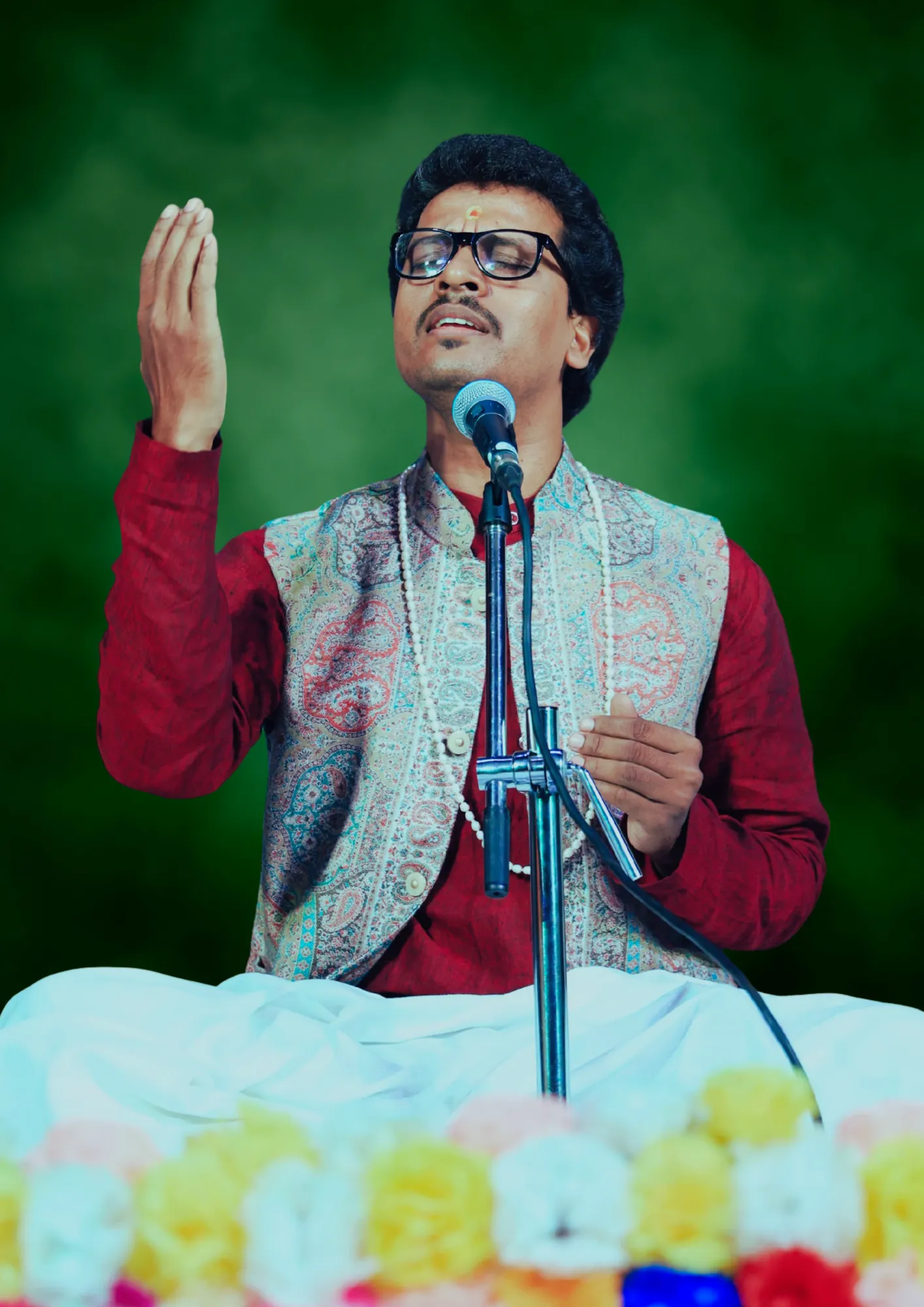
Mukund Dev Sahoo is a Dhrupad vocalist, Guru, and composer in the Dagar Vani tradition, one of the most revered lineages in Indian classical music. He completed his training at the Dhrupad Sansthan, Bhopal, under Padma Shri Gundecha Brothers, direct torchbearers of the Dagar tradition.
Mukund Dev has presented nearly 100 concerts across India and internationally, including the Cosmopolis Festival in Hong Kong, NCPA Mumbai, the Saptak Festival in Ahmedabad, and the International Dhrupad Mela in Varanasi. He is a recognised artist of All India Radio and Doordarshan, an empanelled Guru of SPIC MACAY.
His music has a meditative depth, commanding voice culture, and the rare ability to draw listeners into a state of inner stillness. And that is exactly what he initiates his students into.
Starting the Dhrupad journey with him seems very natural and effortless. No matter whether you have learned music before or not, his sessions will completely change the way you interact with music.
As a Guru, Mukund has trained over 200 students across India and abroad. He brings the ora teaching method of the Gurukul parampara in his online classes. Through the live individual online classes, on the spot feedback and guidance, the transmission of knowledge between the teacher and the student is smooth and effortless.
Mukund is also the creator of Deva Vani Dhrupad, a unique synthesis of mantra, Alap, and Nāda Yoga philosophy that reconnects Dhrupad with its deepest devotional roots while still keeping it relevant for contemporary students worldwide.
... Read More
- Sing Sargam in Sa, Re, Ga, Ma, Pa, Dha, Ni with Shruti precision relative to the Tanpura.
- Perform a basic Alap in Yaman or Bhupali - slow, meditative, in the lower register.
- Sing 1-2 complete Dhrupad Bandish with correct Raga grammar and Tala placement.
- Maintain a daily Kharaj Sadhana and Riyaaz practice with a clear structure.
... Read More
- No prior music experience required. Sincerity and willingness to practise daily are the only prerequisites.
- Stable internet connection
- Quiet practice environment
- Tanpura (instrument or mobile app)
... Read More

Available For All Age-Groups

Online live sessions completed
Available For All Age-Groups
Online live sessions completed
What you get?

World-class masters as teachers

Personalized & Interactive 1-on-1 classes

Course studio that amplifies passion learning

Access to global creative community

Pay as you go - 2 classes at a time

Milestone-based learning for best results

Statement of Accomplishment

Teacher's performance bits for reference
World-class masters as teachers
Personalized & Interactive 1-on-1 classes
Course studio that amplifies passion learning
Access to global creative community
Pay as you go - 2 classes at a time
Milestone-based learning for best results
Statement of Accomplishment
Teacher's performance bits for reference


FAQs
Additional Resources
What Makes ipassio Your Best Fit?

Online, real-time classes
From the comfort of your home, 1 on 1 online interactive classes are scheduled at your convenient time.

World class performers as educators
Award-winning teachers customize the course just for you. Their structured learning methodology lets you always track your progress.

Pay as you go
No long-term commitment. Pay for as few as 2 classes at a time. When you can't make it for the class, you can mutually reschedule with ease.